Macro Space APK

Marco Space app information
| App name | Marco Space |
| Latest version | v6 |
| File size | ~48 MB (placeholder) |
| Category | Games / Adventure |
| Requires Android | Android 6.0+ |
| Developer | Marco Space Studio |
| License | Free (in-app purchases may apply) |
| Last updated | 23 Sept 2026 |
Macro Space Automation: How It Works on Android
Tired of tapping through the same steps over and over? Macro Space lets you record it once — the taps, swipes, whatever pauses you need in between — and save it as a macro. After that, the app just plays it back for you, exactly the same way, every time.
It’s a simple idea, but it’s genuinely useful — anything repetitive, from testing an app to clicking through the same menus every day, can be handed off to a macro instead of done by hand each time.
That said, don’t expect it to work perfectly the moment you hit record. Things like app permissions, screen resolution, timing between steps, and even Android’s own background settings can throw a macro off. Target apps change their layouts too, which can break a macro that worked fine last week. Knowing what can go wrong makes it a lot easier to build macros that actually hold up — and to figure out what happened when one doesn’t.
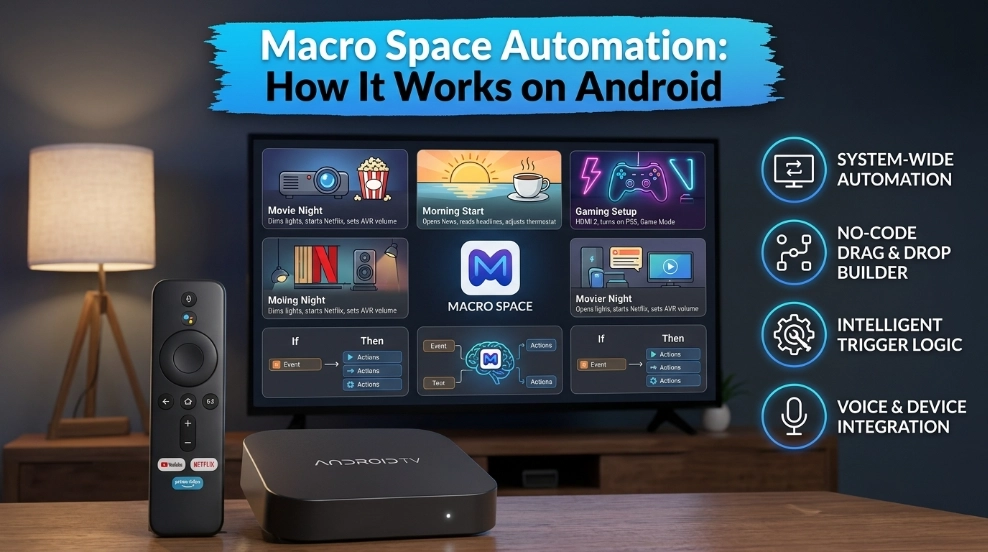
What Is Android Automation?
Android automation allows an application to perform predefined actions on a device. Depending on the tool, these actions can i Macro Space takes care of the repetitive parts for you — things like tapping the screen, swiping, adding a short wait between steps, repeating a sequence, or running any other actions the app supports.
Here’s an example of what that could look like in practice:
Open an app
Tap a button
Wait for the screen to load
Swipe down
Select an option
Repeat the process
On its own, each step barely takes a few seconds. But multiply that by twenty or thirty times a day, and it starts eating into your time for no good reason. This is basically the whole point of Macro Space — record the routine once, and let the app handle the repetition from there.
One thing worth knowing, though: Macro Space isn’t “smart” in the sense of understanding what’s on your screen. It just replays the steps you gave it, in order. So if a random popup interrupts things, or an app updates its layout, Macro Space won’t necessarily notice — it’ll often just carry on to the next step regardless.
Because of that, it’s best suited to tasks that stay predictable — same screens, same steps, every time. Anything that involves a lot of back-and-forth decisions or constantly shifting interfaces is still better handled by hand.
How Macro Recording Works
A macro is simply a saved sequence of actions, performed in the exact order you set them. Automation apps like Macro Space work by recording what you do on your device while you go through the routine once.
Once recording is turned on, things like taps and swipes get captured automatically and added to the sequence. When you’re done, you just save it — and it’s ready to replay whenever you need it.
Here’s a simple example of what that sequence might look like:
- Tap a screen position
- Wait two seconds
- Swipe upward
- Wait one second
- Tap another position
Worth keeping in mind: the Macro Space APK experience isn’t always identical across devices — it can vary a bit depending on your Android version and which release of the app you’re using. Some versions come with extra editing options, while others keep things simple and focus mainly on recording and playback.
Recording is a good starting point, but it’s rarely the final step. It’s worth going back and checking the sequence once it’s saved. If a particular action doesn’t trigger reliably, it usually just needs a small tweak — either the timing or the exact screen position.
How Taps, Swipes, and Delays Work
Screen-based automation really comes down to three basics: actions, positions, and timing. A tap tells the macro where to touch. A swipe covers movement across the screen, from one point to another. And a delay just gives things a brief pause before the next step kicks in. Put together, a simple sequence might look something like this:
Tap → Wait 2 seconds → Swipe → Wait 1 second → Tap
Delays are easy to underestimate, but they matter a lot — especially when an app takes a moment to load the next screen. If you skip the wait, the macro might end up tapping on a button that hasn’t even loaded yet. That said, too much delay isn’t great either. Add unnecessary pauses everywhere, and the whole macro starts to feel slow and clunky. The goal is really just enough time for each step to finish — nothing more.
Then there’s screen position, which trips people up more than they expect. A macro that works perfectly on one phone might not behave the same way on another, simply because screens differ — resolution, scaling, orientation, even layout can all shift things around. So if you’re after consistent results, the safest bet is to build and test your macro on the same device you’re planning to actually use it on.
Permissions and Accessibility Access
Automation applications may require special Android access because standard applications cannot freely control other apps. Most automation apps lean on Android’s Accessibility service to “see” what’s happening on your screen and carry out actions for you — taps, swipes, and so on. On top of that, depending on what the app actually offers, you might get prompted for a few extra permissions here and there.
Before you enable anything, it’s worth actually reading what Android says that permission does — and thinking about whether it’s really needed for the feature you’re trying to use.
When installing macro space apk original, the source of the APK should also be checked separately. A download page calling a file “original” does not automatically prove that the package is unmodified. Permissions explain what access an application requests. They do not prove where an APK came from or whether its contents have been changed.
How to Create a Basic Macro
Creating a simple macro usually does not require programming. The process is based on recording or adding actions in the order they need to happen.
A typical workflow is:
- Open the automation application
- Create a new macro
- Start recording
- Perform the required actions
- Add suitable delays
- Stop recording
- Save the sequence
- Play it back
Start with a short routine rather than creating a long sequence immediately. A smaller macro is easier to understand and troubleshoot.
For example, if a task has ten actions, first make sure the first three or four work correctly. Then add the remaining steps. This approach makes it easier to identify the action causing a problem. You do not have to troubleshoot an entire sequence when only one part is responsible for the failure.
What Is a Macro Panel?
A macro panel is a control interface that provides quick access to saved automation sequences. It can be useful when you want to start or stop a macro without repeatedly opening the main automation interface.
A macro space panel apk may provide options such as:
- Starting a saved macro
- Stopping an active sequence
- Selecting between saved macros
- Opening automation settings
- Accessing available shortcuts
The panel acts as a convenient control layer, while the saved macro contains the actions that are actually played back.If you’re hunting for a panel APK, double-check the exact app name, version number, and package details before you download anything. Just because two download pages use a similar-sounding name doesn’t mean they’re offering the same app — or even the same release.
Automation for Games and Repetitive Tasks
Mobile gaming is one area where automation searches are common. Some users may search for macro space apk free fire to find out whether automated taps or gestures can be used with a particular game.Technical capability and permitted use are separate issues. A macro may be able to reproduce taps or swipes, but a game’s rules or terms may restrict automated input.
Game interfaces can also change after updates. A sequence based on fixed screen positions may stop working when buttons move or new screens are introduced.Outside gaming, screen automation can also be useful for repetitive tasks in applications where automated interaction is supported. It is most practical when the same actions need to be performed in a predictable order.
Android Compatibility
Automation performance can vary between Android devices. The Android version, manufacturer settings, display configuration, and background restrictions can all affect playback.
Important factors include:
- Android version
- Device manufacturer
- Screen resolution and display scaling
- Accessibility settings
- Battery optimization
- Background restrictions
- Changes in the target application
A macro that works on one phone may need adjustments on another. This does not necessarily mean the automation tool is broken. The device environment can affect how screen-based actions are interpreted.If you are researching macro space apk 2026, treat the year in the search phrase as a release or search term rather than a compatibility guarantee. The actual Android requirements of the specific version matter more.
What to Check Before Using an Automation App
A few basic checks can prevent common setup problems.
Android Version
Check whether the application supports the Android version installed on your phone. Older releases may behave differently on newer versions of Android.
Accessibility Access
Confirm that the required accessibility service is enabled. If Android disables or restricts the service, automation may stop working.
Target App Compatibility
The automation tool may work correctly while the target app behaves differently. Interface changes, popups, loading screens, or restrictions can interrupt playback.
Battery and Background Settings
Some Android devices limit background activity to save battery. These restrictions can interfere with services that need to remain active.
APK Information
If you install an APK outside an official app store, check its source, version, package information, and requested permissions. Do not rely only on labels such as “original,” “latest,” or “safe.”
Why a Macro May Stop Working
A macro can work correctly at first and fail later because something around it has changed.
For example, the target application might receive an update that moves a button or adds another screen. A popup could also appear where the macro expects another control.
Android settings can create problems as well. Battery optimization may restrict background activity, or an accessibility service may have been disabled.
If a saved sequence stops working, check:
- Whether required permissions are still enabled
- Whether the target app has been updated
- Whether screens now take longer to load
- Whether the device orientation has changed
- Whether battery restrictions are active
- Which specific action fails during playback
If only one action is affected, you may only need to adjust that part instead of recording the entire macro again.
Battery Usage and Background Operation
Automation can consume additional battery when it repeatedly interacts with the screen or keeps a service active in the background.
The effect depends on how the automation is configured. A short sequence that runs once generally creates less activity than a macro that repeats continuously for a long period.
If battery usage becomes noticeable, reduce unnecessary repetitions and stop automation when it is no longer needed.
Background restrictions can also interrupt a running sequence. If automation stops unexpectedly, check your device’s battery and background activity settings.
Choosing the Right APK Version
Different APK pages may list different release numbers. For example, a search for macro space v8 apk could produce packages from different websites or releases.
The version number alone should not determine which file you install. Check whether the release supports your Android version and whether its information matches the application you are looking for.
Before installing an APK, check:
- Android compatibility: Confirm that the release supports your device.
- Version information: Check the exact release number.
- Source: Consider whether the provider is trustworthy.
- Permissions: Make sure requested access makes sense for the app’s functions.
- File type: Be cautious with modified or repackaged packages.
- Basic testing: Check the main functions before relying on the application regularly.
The phrase macro space download can return multiple APK pages, so do not assume that every result comes from the same developer or represents the same release.
An older version is not automatically better, and a newer version is not automatically compatible with every device. The suitable release depends on your Android environment, the application’s requirements, and the source of the file.
Safe APK Installation Practices
Installing an APK outside an official app store requires additional care because the file comes from a source you must evaluate yourself.
Before opening an APK, consider where it came from and whether the source is trustworthy. Modified packages may contain changes that are not part of the original application.
Useful precautions include:
- Download from a source you trust
- Check the exact version before installing
- Review requested permissions
- Be cautious with modified packages
- Keep Android security features enabled
- Remove applications you no longer need
If Android displays a security warning, read it before continuing.
Words such as “original,” “latest,” and “mod” are labels used on download pages. They do not independently prove what is inside an APK. Source information, package details, and file integrity are more useful when evaluating a file.
How to Make Automation More Reliable
Reliable automation usually comes from keeping the sequence simple and matching its timing to the task.Avoid unnecessary actions. If a routine needs five steps, adding many extra interactions creates more opportunities for something to fail.
Use realistic delays when a screen needs time to load. At the same time, avoid excessive waiting that makes the sequence unnecessarily slow.Keep the same starting conditions when possible. Changes in screen orientation, display settings, or the target app can affect fixed-position actions.
When an application is updated, check the actions that interact with the changed screens first. A small adjustment to timing, position, or action order may solve the problem without rebuilding the entire sequence.
Benefits and Limitations of Android Automation
Automation can reduce repetitive work, but it works best when the environment remains predictable.
Benefits
- Reduces repetitive manual actions
- Can save time on routine workflows
- Provides consistent sequences
- Allows saved macros to be reused
- Simplifies repeated screen interactions
Limitations
- Macros can fail when an interface changes
- Timing affects playback
- Special permissions may be required
- Different devices can behave differently
- Some applications may restrict automated actions
- Long-running automation can increase battery usage
Understanding these limitations helps set realistic expectations. A macro follows predefined instructions, so it cannot always adapt when the conditions around it change.
Frequently Asked Questions
What is Android automation?
Android automation allows an application to perform predefined actions such as taps, swipes, waits, and repeated sequences. It is mainly useful for predictable tasks that follow the same steps.
Does Macro Space require programming?
Basic macro creation generally does not require programming. Users can record or configure supported actions and arrange them into a sequence.
Why does my macro tap the wrong place?
Fixed screen positions can be affected by screen resolution, display scaling, orientation, or changes to the target application’s interface. Check the device layout and adjust the affected action if necessary.
Why does my macro stop after an Android update?
An Android update can change permissions, accessibility behavior, battery restrictions, or other system settings. Check the application’s permissions and background settings after updating Android.
Can automation work in mobile games?
It may technically reproduce supported taps or gestures, but individual games can have rules or terms that restrict automated input. Check the specific game’s current rules before using automation.
Is every Macro Space APK original?
No APK should be considered original simply because a download page uses that label. Check the source, application details, version information, and package information before installing.
Why is my automation running too slowly?
Long delays between actions can increase the total runtime. Review the sequence and reduce unnecessary waiting while keeping enough time for screens and buttons to load properly.
Can the same macro work on different Android phones?
It may, but results can vary. Differences in screen size, resolution, display scaling, Android versions, and interface layouts can affect fixed-position automation.
Why does automation stop in the background?
Android battery optimization and manufacturer-specific background restrictions can limit applications running in the background. Check the relevant battery and background activity settings on the device.
Should I use an old or new APK version?
Choose a release based on Android compatibility, application requirements, source reliability, and the features you actually need. A newer version is not automatically suitable for every device.
Final Thoughts
Android automation works by saving a sequence of actions and replaying them in the required order. Its reliability depends on factors such as timing, screen layout, permissions, device settings, and changes to the target application.When researching an automation APK, look beyond the version name. Check Android compatibility, requested permissions, the source of the file, and whether the target application supports the type of interaction you want to automate.
For predictable routines, a well-structured macro can reduce repetitive manual work. When a task changes frequently or requires decisions at each step, manual interaction may be more practical.Start with a short sequence, use sensible timing, and check the macro again whenever the device or target application changes. This makes Android automation easier to manage and troubleshoot.